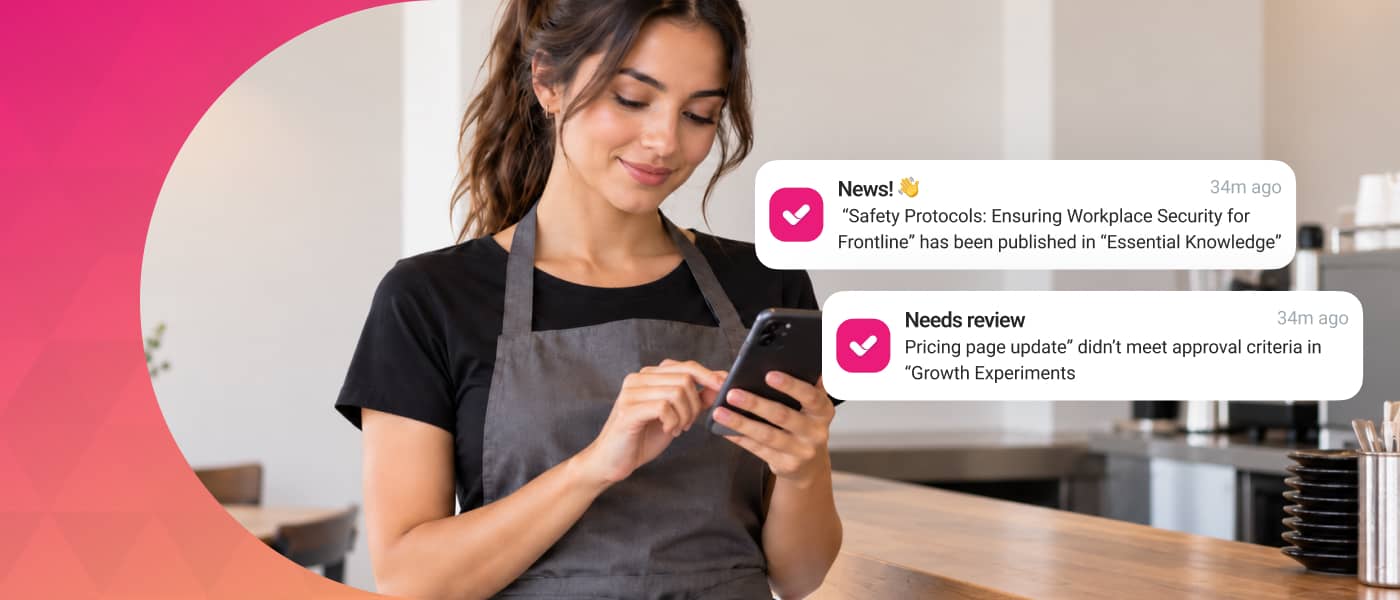
Internal communication apps for companies are no longer an optional extra. They are the infrastructure that decides whether information arrives — or gets lost — before it reaches the person who needs it. But not all apps serve the same purpose: choosing the wrong tool can create more noise than coordination.
An internal communication app for companies is a platform that centralizes information flows between the organization and its employees, ensuring the right messages reach the right people at the right time, with traceability and without relying on email or personal WhatsApp.
Why not every internal communication app works for your company
The most common mistake when choosing an internal communication tool is projecting the needs of office-based teams onto the whole organization. Slack and Microsoft Teams work very well for teams that work at a computer. But there are 2.7 billion deskless workers worldwide — data from Pickcel, 2026 — who don’t have a corporate email account, don’t spend the day in front of a screen, and need to receive information between shifts from their personal phone.
For this profile — store employees, logistics staff, hospitality teams, or field workers — tools designed for offices aren’t just uncomfortable: they simply don’t work. The result is usually always the same: announcements end up in an informal WhatsApp group, with no traceability, no read receipts, and messages that get lost in the scroll.
Before choosing an app, the first question isn’t “which tool is best?” but “what kind of team do I have?” To learn more about the specific challenges of this profile, check out our guide on internal communication tools.
What an internal communication app needs for deskless teams
Not every feature listed in software catalogs is equally relevant for frontline teams. These are the truly essential capabilities according to the Gallagher State of the Sector 2024 report, which notes that 60% of organizations consider reaching frontline employees their main internal communication challenge:
Criterion
Why it's essential
Warning sign
No corporate email required
Most frontline employees don't have a company email
The app requires a corporate account to activate
Native mobile-first design
The personal phone is the only device available during a shift
The interface is just a scaled-down version of the desktop version
Segmentable push notifications
Not everyone needs to receive every message
Only mass sending exists, with no segmentation by shift or location
Read analytics
You need to know who has received each communication
There's no open data or delivery confirmation
Feedback from mobile
Communication needs to be two-way
It only allows posting, not collecting structured responses
The best internal communication apps for companies: 2026 comparison
The internal communication app market is split into two main groups: tools designed for office-based teams (with messaging, collaboration, and video conferencing features) and platforms designed specifically for deskless teams. Below, we analyze the most relevant options in each category.
Messaging apps for office teams: Slack, Microsoft Teams, and Google Chat
These three tools dominate the corporate communication market for office-based teams. They’re powerful, deeply integrated with other systems, and enjoy very high adoption. The problem arises when companies try to extend them to the whole organization, including deskless employees.
Slack is the benchmark for channel-based messaging. It has more than 2,600 integrations with other tools and a very polished user experience. It’s ideal for teams of 10 to 500 people with a digital work culture. Paid plans start at $7.25 per user/month. The limit for frontline teams: it requires a corporate email account and its interface isn’t designed for intermittent mobile use.
Microsoft Teams is the natural choice for companies already working with Microsoft 365. It includes video conferencing for up to 1,000 participants, collaborative document editing, and advanced regulatory compliance (GDPR, HIPAA, ISO). Plans start from $4/user/month. For deskless teams, the learning curve is steep and the mobile experience isn’t designed for operational environments.
Google Chat is built into Google Workspace and is the most affordable option for teams already using the Google ecosystem. Included in plans starting at €6/user/month. Its biggest limitation for frontline use: a smaller integration catalog than Slack and no specific features for distributed teams.
Tool
Price from
Best for
Slack
$7.25/user/month
Digital teams with many integrations
Microsoft Teams
$4/user/month
Companies with a Microsoft 365 ecosystem
Google Chat
Included in Workspace
Teams using Google Workspace
Apps for deskless employees: isEazy Engage and the main alternatives
These platforms were born to solve exactly the problem that Slack or Teams can’t: reaching employees who don’t work in an office, don’t have a corporate email account, and need to receive information immediately from their personal phone. Below are the main market alternatives for deskless teams:
1. isEazy Engage
isEazy Engage is a platform designed specifically for frontline teams that brings together the management and oversight of operations, communication, and training in a single app. Unlike general-purpose messaging apps, Engage lets you measure whether execution is consistent across every point of sale, collect structured feedback from stores, and speed up onboarding for new employees — with no need for a corporate email account and a mobile-first experience built for retail, logistics, and hospitality environments.
isEazy Engage
Features
Benefits
Pricing
Task management: Create and assign tasks effortlessly, plan and launch campaigns in real time, monitor progress across each location, and provide instant validation and feedback.
Instant communication: Interactive newsfeed, push notifications, chats and surveys, likes and comments. Launch your own communication channel to keep all your teams aligned with campaigns, promotions, and updates.
On-the-go training: Microlearning experiences, knowledge library, games and challenges, and training tracking. Agile and engaging learning adapted to the daily workflow of frontline teams.
Analytics: Comprehensive dashboard with key metrics on tasks, communication, and training. Access detailed reports instantly or schedule them to make strategic decisions in real time.
Document manager: Keep all documentation in one place, organized and structured by areas, folders, or tags, and available at every professional’s fingertips.
Gamification: Points, rankings, and rewards whenever employees review a document, interact with content, or participate in a game.
Collaborative environment: Employees can create and share their own content, add images, videos, and all kinds of external resources.
Roles and permissions: Control access to content, communications, and tasks by configuring roles and permissions based on department, region, or employee profile.
Integrated Artificial Intelligence: Manage projects more easily and find any content in seconds, even within multimedia resources.
Everything in one place: Operational management, instant communication, and on-the-go training centralized in a single app, eliminating the need for multiple tools.
Always aligned teams: Keep all your frontline professionals updated on everything happening in your business, from campaigns and promotions to internal procedures.
Multi-location management: Supervise teams and tasks across multiple stores or franchises from a single platform, with real-time visibility into operations.
Greater engagement and knowledge retention: The combination of training and gamification has achieved over 90% knowledge retention in customers such as Shiseido.
Full customization: Configure the app with your corporate identity and segment content, communications, and tasks according to departments, regions, or employee profiles.
Real-time decision-making: Comprehensive dashboard that allows you to visualize key metrics and access detailed reports on team performance whenever needed.
Designed for frontline workers: 80% of today’s workforce consists of frontline workers. 78% prefer using mobile devices to access information, and 68% consume content more effectively through microlearning experiences.
Flexible pricing model based on each company’s needs. Contact the isEazy Engage team to receive a personalized proposal.
Features
Task management: Create and assign tasks effortlessly, plan and launch campaigns in real time, monitor progress across each location, and provide instant validation and feedback.
Instant communication: Interactive newsfeed, push notifications, chats and surveys, likes and comments. Launch your own communication channel to keep all your teams aligned with campaigns, promotions, and updates.
On-the-go training: Microlearning experiences, knowledge library, games and challenges, and training tracking. Agile and engaging learning adapted to the daily workflow of frontline teams.
Analytics: Comprehensive dashboard with key metrics on tasks, communication, and training. Access detailed reports instantly or schedule them to make strategic decisions in real time.
Document manager: Keep all documentation in one place, organized and structured by areas, folders, or tags, and available at every professional’s fingertips.
Gamification: Points, rankings, and rewards whenever employees review a document, interact with content, or participate in a game.
Collaborative environment: Employees can create and share their own content, add images, videos, and all kinds of external resources.
Roles and permissions: Control access to content, communications, and tasks by configuring roles and permissions based on department, region, or employee profile.
Integrated Artificial Intelligence: Manage projects more easily and find any content in seconds, even within multimedia resources.
Benefits
Everything in one place: Operational management, instant communication, and on-the-go training centralized in a single app, eliminating the need for multiple tools.
Always aligned teams: Keep all your frontline professionals updated on everything happening in your business, from campaigns and promotions to internal procedures.
Multi-location management: Supervise teams and tasks across multiple stores or franchises from a single platform, with real-time visibility into operations.
Greater engagement and knowledge retention: The combination of training and gamification has achieved over 90% knowledge retention in customers such as Shiseido.
Full customization: Configure the app with your corporate identity and segment content, communications, and tasks according to departments, regions, or employee profiles.
Real-time decision-making: Comprehensive dashboard that allows you to visualize key metrics and access detailed reports on team performance whenever needed.
Designed for frontline workers: 80% of today’s workforce consists of frontline workers. 78% prefer using mobile devices to access information, and 68% consume content more effectively through microlearning experiences.
Pricing
Flexible pricing model based on each company’s needs. Contact the isEazy Engage team to receive a personalized proposal.
2. Beekeeper
Beekeeper is a communication platform aimed at frontline teams in hospitality, retail, manufacturing, and logistics. It allows segmented announcements, digitizes workflows such as checklists and shift reports, and offers automatic translation for multilingual teams. Its integration with HR and payroll systems is one of its strengths, although its cost tends to be high for mid-sized companies and it’s less focused on operational management than on communication.
Beekeeper by Lumapps
Features
Advantages
Disadvantages
Pricing
Internal communication: targeted communications by role, shift, or location, news streams, chats, and campaigns to keep frontline teams informed and connected without requiring corporate email.
Task management: create, assign, and track tasks to organize daily work and monitor execution directly from mobile devices.
Checklists, forms, and workflows: digitize operational processes with checklists, forms, incident reports, and automated workflows to reduce manual processes.
Training and onboarding: mobile access to training content, onboarding, compliance courses, statistics, certificates, and learning progress through LumApps Learning.
Knowledge access: Beekeeper is now part of the LumApps AI Employee Hub, progressively expanding frontline access to corporate information, resources, and knowledge from a connected environment.
Process automation: automate actions such as approvals, onboarding steps, compliance reminders, and certain employee-related workflows.
Micro-Apps: bring actions from third-party business systems into the employee experience so workers can complete certain processes directly from their home screen.
Integrations: connects with tools such as Workday, ServiceNow, SAP SuccessFactors, UKG, and other enterprise systems used by employees.
Analytics: dashboards for monitoring communication reach, engagement, task completion, and workflow performance across different locations.
Progressive AI integration: its integration with LumApps is expanding Beekeeper with search, assistants, and other AI capabilities, although part of this unified experience is still being rolled out in phases.
Built for frontline teams: Beekeeper was purpose-built for employees without a fixed desk or regular access to corporate email and computers.
Mobile-first communication: enables targeted information distribution and two-way communication between organizations and distributed teams.
Process digitization: tasks, checklists, forms, and workflows help move processes traditionally managed on paper into a mobile environment.
Broad integration ecosystem: provides access to different enterprise systems and connects tools already used by the organization.
Broader scope through LumApps: Beekeeper is becoming part of an Employee Hub designed to progressively connect both desk-based and frontline employees.
Learning in the flow of work: LumApps Learning brings onboarding, training, and compliance content into the mobile environment employees already use.
Product integration is still underway: Beekeeper and LumApps are rolling out a unified product experience in phases, so not every LumApps capability is currently integrated into the existing Beekeeper experience in the same way.
Learning requires an add-on: LumApps Learning is available to Beekeeper customers as an add-on and requires an Essential or Core package with the Learning add-on.
Feature availability depends on the plan: certain Tasks capabilities and other tools may vary depending on the subscription package selected.
Strong Employee Hub and communications focus: its proposition places significant emphasis on communications, access to enterprise tools, and the broader digital employee experience, while training, gamification, and workforce activation are not its only focus.
Less emphasis on gamification: while learning includes elements such as certificates and leaderboards, points, games, challenges, and rewards linked across different employee interactions are not as central to the overall proposition.
Reliance on integrations for some processes: certain HR, IT, scheduling, and business processes depend on connecting external systems through integrations or Micro-Apps.
Less transparent pricing during the transition: the current offering directs new customers to the sales team, and LumApps has indicated that its pricing strategy will evolve as new capabilities, packages, and add-ons are introduced.
Beekeeper by LumApps does not currently display fixed pricing for new projects on its product page, so organizations need to contact the sales team for a proposal tailored to their requirements.
For existing Beekeeper customers, LumApps has stated that current contracts and pricing remain unchanged during the transition. As the two solutions become more deeply integrated, the company expects its commercial strategy to evolve with new packages or add-ons associated with expanded capabilities.
Features
Internal communication: targeted communications by role, shift, or location, news streams, chats, and campaigns to keep frontline teams informed and connected without requiring corporate email.
Task management: create, assign, and track tasks to organize daily work and monitor execution directly from mobile devices.
Checklists, forms, and workflows: digitize operational processes with checklists, forms, incident reports, and automated workflows to reduce manual processes.
Training and onboarding: mobile access to training content, onboarding, compliance courses, statistics, certificates, and learning progress through LumApps Learning.
Knowledge access: Beekeeper is now part of the LumApps AI Employee Hub, progressively expanding frontline access to corporate information, resources, and knowledge from a connected environment.
Process automation: automate actions such as approvals, onboarding steps, compliance reminders, and certain employee-related workflows.
Micro-Apps: bring actions from third-party business systems into the employee experience so workers can complete certain processes directly from their home screen.
Integrations: connects with tools such as Workday, ServiceNow, SAP SuccessFactors, UKG, and other enterprise systems used by employees.
Analytics: dashboards for monitoring communication reach, engagement, task completion, and workflow performance across different locations.
Progressive AI integration: its integration with LumApps is expanding Beekeeper with search, assistants, and other AI capabilities, although part of this unified experience is still being rolled out in phases.
Advantages
Built for frontline teams: Beekeeper was purpose-built for employees without a fixed desk or regular access to corporate email and computers.
Mobile-first communication: enables targeted information distribution and two-way communication between organizations and distributed teams.
Process digitization: tasks, checklists, forms, and workflows help move processes traditionally managed on paper into a mobile environment.
Broad integration ecosystem: provides access to different enterprise systems and connects tools already used by the organization.
Broader scope through LumApps: Beekeeper is becoming part of an Employee Hub designed to progressively connect both desk-based and frontline employees.
Learning in the flow of work: LumApps Learning brings onboarding, training, and compliance content into the mobile environment employees already use.
Disadvantages
Product integration is still underway: Beekeeper and LumApps are rolling out a unified product experience in phases, so not every LumApps capability is currently integrated into the existing Beekeeper experience in the same way.
Learning requires an add-on: LumApps Learning is available to Beekeeper customers as an add-on and requires an Essential or Core package with the Learning add-on.
Feature availability depends on the plan: certain Tasks capabilities and other tools may vary depending on the subscription package selected.
Strong Employee Hub and communications focus: its proposition places significant emphasis on communications, access to enterprise tools, and the broader digital employee experience, while training, gamification, and workforce activation are not its only focus.
Less emphasis on gamification: while learning includes elements such as certificates and leaderboards, points, games, challenges, and rewards linked across different employee interactions are not as central to the overall proposition.
Reliance on integrations for some processes: certain HR, IT, scheduling, and business processes depend on connecting external systems through integrations or Micro-Apps.
Less transparent pricing during the transition: the current offering directs new customers to the sales team, and LumApps has indicated that its pricing strategy will evolve as new capabilities, packages, and add-ons are introduced.
Pricing
Beekeeper by LumApps does not currently display fixed pricing for new projects on its product page, so organizations need to contact the sales team for a proposal tailored to their requirements.
For existing Beekeeper customers, LumApps has stated that current contracts and pricing remain unchanged during the transition. As the two solutions become more deeply integrated, the company expects its commercial strategy to evolve with new packages or add-ons associated with expanded capabilities.
3. Connecteam
Connecteam is an all-in-one app designed to manage deskless teams that combines communication, shift management, checklists, and training on a single platform. It’s especially popular among SMBs with distributed teams thanks to its ease of implementation and accessible pricing model. Its weak point compared to more specialized solutions is the depth of its analytics and advanced customization for large corporate environments.
Connecteam
Features
Benefits
Task management: enables organizations to create, assign, and track individual or group tasks for frontline teams.
Recurring tasks: allows selected activities to be scheduled repeatedly with due dates and reminders.
Internal communication: includes individual and group chat to support communication between employees.
Updates feed: enables organizations to publish announcements, news, and updates for the entire workforce or selected groups.
Targeted communication: allows selected posts and content to be delivered according to defined employee groups.
Mobile learning: enables organizations to create and distribute learning content accessible from mobile devices and computers.
Microlearning: allows training to be structured into short sections and content that can be completed during the workday.
Courses and quizzes: enables learning content to be organized into courses and includes questions for checking selected knowledge.
Onboarding: allows organizations to structure courses and resources for new frontline employees.
Knowledge base: enables selected internal documents and resources to be centralized for employee access.
Notifications and reminders: supports alerts related to tasks, communications, and outstanding training.
Tracking: provides information on task execution and the progress and completion of selected learning content.
Frontline team focus: is designed for organizations with distributed employees who may not have a fixed workstation or regular access to a computer.
Digital task management: enables selected operational activities to be moved into a digital environment and tracked.
Targeted communication: facilitates the distribution of messages and updates to different employee groups.
Learning during the workday: supports short-form content that employees can access from mobile devices.
Mobile onboarding: enables organizations to structure dedicated content for the first stages of the employee onboarding process.
Knowledge access: enables selected documents and internal resources to be grouped for employee consultation.
Centralized tracking: provides visibility into task and learning activity within the Connecteam environment.
Features
Task management: enables organizations to create, assign, and track individual or group tasks for frontline teams.
Recurring tasks: allows selected activities to be scheduled repeatedly with due dates and reminders.
Internal communication: includes individual and group chat to support communication between employees.
Updates feed: enables organizations to publish announcements, news, and updates for the entire workforce or selected groups.
Targeted communication: allows selected posts and content to be delivered according to defined employee groups.
Mobile learning: enables organizations to create and distribute learning content accessible from mobile devices and computers.
Microlearning: allows training to be structured into short sections and content that can be completed during the workday.
Courses and quizzes: enables learning content to be organized into courses and includes questions for checking selected knowledge.
Onboarding: allows organizations to structure courses and resources for new frontline employees.
Knowledge base: enables selected internal documents and resources to be centralized for employee access.
Notifications and reminders: supports alerts related to tasks, communications, and outstanding training.
Tracking: provides information on task execution and the progress and completion of selected learning content.
Benefits
Frontline team focus: is designed for organizations with distributed employees who may not have a fixed workstation or regular access to a computer.
Digital task management: enables selected operational activities to be moved into a digital environment and tracked.
Targeted communication: facilitates the distribution of messages and updates to different employee groups.
Learning during the workday: supports short-form content that employees can access from mobile devices.
Mobile onboarding: enables organizations to structure dedicated content for the first stages of the employee onboarding process.
Knowledge access: enables selected documents and internal resources to be grouped for employee consultation.
Centralized tracking: provides visibility into task and learning activity within the Connecteam environment.
4. Yoobic
Yoobic is an operations and communication platform for frontline teams with a strong presence in retail and fashion. It allows you to manage visual store audits, visual merchandising campaigns, and operational announcements from a single app. Its focus is heavily oriented toward in-store execution, with photo verification features and real-time reporting for area managers. It’s a solid option for retailers with many locations that need execution control.
Yoobic
Features
Benefits
Task management: enables organizations to create, assign, and track tasks for specific stores, locations, or employee groups.
Activity planning: supports the organization of tasks and actions according to dates, priorities, and audiences.
Internal communications: enables news, messages, and updates to be distributed to frontline teams.
Targeted communications: enables selected content to be delivered according to employee role, location, or group.
Microlearning: delivers short-form learning content designed to fit into the workday of frontline teams.
Content creation: includes tools for developing courses, quizzes, and other learning resources.
Onboarding: enables organizations to structure learning content and activities for new hires.
Learning tracking: provides visibility into participation, progress, and completion of assigned learning content.
Analytics: provides dashboards and reports related to tasks, learning, and team activity.
Mobile access: enables employees to review tasks, communications, and learning content from mobile devices.
Integrations: allows YOOBIC to connect with selected business systems and tools.
Frontline team focus: is primarily designed for organizations with employees distributed across multiple stores or locations.
Digital task management: enables selected manual processes to be replaced with assigned and trackable tasks.
Targeted communications: supports the distribution of information to different stores, roles, or employee groups.
Learning during the workday: enables short learning content to be incorporated into employees’ daily routines.
Tasks and learning: enables selected operational initiatives to be accompanied by learning content.
Mobile access: facilitates access to tasks, communications, and learning from different devices.
Centralized tracking: provides information related to task execution and learning activity.
Features
Task management: enables organizations to create, assign, and track tasks for specific stores, locations, or employee groups.
Activity planning: supports the organization of tasks and actions according to dates, priorities, and audiences.
Internal communications: enables news, messages, and updates to be distributed to frontline teams.
Targeted communications: enables selected content to be delivered according to employee role, location, or group.
Microlearning: delivers short-form learning content designed to fit into the workday of frontline teams.
Content creation: includes tools for developing courses, quizzes, and other learning resources.
Onboarding: enables organizations to structure learning content and activities for new hires.
Learning tracking: provides visibility into participation, progress, and completion of assigned learning content.
Analytics: provides dashboards and reports related to tasks, learning, and team activity.
Mobile access: enables employees to review tasks, communications, and learning content from mobile devices.
Integrations: allows YOOBIC to connect with selected business systems and tools.
Benefits
Frontline team focus: is primarily designed for organizations with employees distributed across multiple stores or locations.
Digital task management: enables selected manual processes to be replaced with assigned and trackable tasks.
Targeted communications: supports the distribution of information to different stores, roles, or employee groups.
Learning during the workday: enables short learning content to be incorporated into employees’ daily routines.
Tasks and learning: enables selected operational initiatives to be accompanied by learning content.
Mobile access: facilitates access to tasks, communications, and learning from different devices.
Centralized tracking: provides information related to task execution and learning activity.
5. WorkJam
WorkJam positions itself as a “digital workplace” platform for frontline teams that combines communication, shift management, training, and engagement in a single app. It has a significant presence among large retailers and hospitality companies in the US and Europe. Its strength lies in workforce management (WFM) integrated with communication, although its implementation tends to be complex and it’s mainly aimed at large accounts.
WorkJam
Features
Advantages
Disadvantages
Pricing
Task management: create, assign, and track tasks for frontline teams, with prioritization by employee and shift, forms, and photo or video verification.
Internal communication: segmented channels, targeted messages, chats, comments, surveys, live broadcasts, and notifications to keep distributed teams connected.
Training and knowledge: microlearning, learning paths, certifications, and a knowledge hub for distributing procedures, policies, and resources to employees.
Shift management: employees can view, swap, drop, and request shifts from their mobile devices, as well as access an internal marketplace for available shifts.
Audits and forms: digitization of checklists and operational audits, with scoring, issue tracking, and the ability to generate corrective actions.
Content segmentation: distribution of communications, tasks, and training based on criteria such as location, role, department, certifications, or shift.
Operational analytics: dashboards to monitor tasks, communications, training, audits, and other indicators related to frontline team activity.
AI and workflow automation: uses AI and automation rules to connect information from different business systems with tasks, communications, and other employee actions.
Integrations: connects with WFM, HCM, ERP, LMS, and other corporate systems to expand employee access through a single interface.
Built for frontline teams: specifically designed for organizations with distributed, shift-based employees who do not have permanent access to a corporate computer.
Broad operational scope: combines tasks, communication, training, audits, and shift management within the same ecosystem.
Advanced segmentation: enables organizations to target actions and content based on location, role, shift, department, or certifications.
Enterprise system integrations: can act as an access layer for workforce management, planning, and operational systems already used by the organization.
Multi-location management: provides visibility into frontline team activity and execution across different stores, sites, or locations.
Training connected to daily work: allows certain tasks, audits, or operational needs to be linked to training content and knowledge resources.
Modular structure: not every capability is included in a single plan. Features such as tasks, audits, forms, shift management, or certain learning functions are offered as add-ons within its public Frontline Connect plans.
Costs can increase with add-ons: organizations that want to combine communication, task management, training, and additional operational capabilities may need to purchase several modules on top of the core plan.
High starting price for some projects: its Essential plan starts at $799 per month, billed annually, for up to 500 users, which may be oversized for companies with more limited requirements.
Greater functional complexity: its combination of WFM, shift management, audits, integrations, tasks, and training may require a broader implementation than companies need if their priority is simply to manage, communicate with, and train frontline teams.
Strong workforce management focus: capabilities such as scheduling, shift swaps, attendance, and staffing coverage are an important part of its proposition, even though they are not a priority for every organization.
Additional services may require separate pricing: certain integrations, data sources, implementation services, training, and advanced support may require additional contracts or fees.
WorkJam publishes pricing for its Frontline Connect solution. The Essential plan starts at $799 per month for up to 500 users, billed annually. Operations Elite 500 starts at $1,599 per month for up to 500 users, while Operations Elite 1000 starts at $2,499 per month for up to 1,000 users.
Some capabilities are sold as paid add-ons. For example, with Operations Elite 500, Productivity Plus —including tasks, audits, and forms— costs an additional $999 per month, Staffing Plus another $999 per month, and Skilling Plus an additional $299 per month. Organizations with more than 1,000 users or additional service requirements need to contact WorkJam’s sales team.
Features
Task management: create, assign, and track tasks for frontline teams, with prioritization by employee and shift, forms, and photo or video verification.
Internal communication: segmented channels, targeted messages, chats, comments, surveys, live broadcasts, and notifications to keep distributed teams connected.
Training and knowledge: microlearning, learning paths, certifications, and a knowledge hub for distributing procedures, policies, and resources to employees.
Shift management: employees can view, swap, drop, and request shifts from their mobile devices, as well as access an internal marketplace for available shifts.
Audits and forms: digitization of checklists and operational audits, with scoring, issue tracking, and the ability to generate corrective actions.
Content segmentation: distribution of communications, tasks, and training based on criteria such as location, role, department, certifications, or shift.
Operational analytics: dashboards to monitor tasks, communications, training, audits, and other indicators related to frontline team activity.
AI and workflow automation: uses AI and automation rules to connect information from different business systems with tasks, communications, and other employee actions.
Integrations: connects with WFM, HCM, ERP, LMS, and other corporate systems to expand employee access through a single interface.
Advantages
Built for frontline teams: specifically designed for organizations with distributed, shift-based employees who do not have permanent access to a corporate computer.
Broad operational scope: combines tasks, communication, training, audits, and shift management within the same ecosystem.
Advanced segmentation: enables organizations to target actions and content based on location, role, shift, department, or certifications.
Enterprise system integrations: can act as an access layer for workforce management, planning, and operational systems already used by the organization.
Multi-location management: provides visibility into frontline team activity and execution across different stores, sites, or locations.
Training connected to daily work: allows certain tasks, audits, or operational needs to be linked to training content and knowledge resources.
Disadvantages
Modular structure: not every capability is included in a single plan. Features such as tasks, audits, forms, shift management, or certain learning functions are offered as add-ons within its public Frontline Connect plans.
Costs can increase with add-ons: organizations that want to combine communication, task management, training, and additional operational capabilities may need to purchase several modules on top of the core plan.
High starting price for some projects: its Essential plan starts at $799 per month, billed annually, for up to 500 users, which may be oversized for companies with more limited requirements.
Greater functional complexity: its combination of WFM, shift management, audits, integrations, tasks, and training may require a broader implementation than companies need if their priority is simply to manage, communicate with, and train frontline teams.
Strong workforce management focus: capabilities such as scheduling, shift swaps, attendance, and staffing coverage are an important part of its proposition, even though they are not a priority for every organization.
Additional services may require separate pricing: certain integrations, data sources, implementation services, training, and advanced support may require additional contracts or fees.
Pricing
WorkJam publishes pricing for its Frontline Connect solution. The Essential plan starts at $799 per month for up to 500 users, billed annually. Operations Elite 500 starts at $1,599 per month for up to 500 users, while Operations Elite 1000 starts at $2,499 per month for up to 1,000 users.
Some capabilities are sold as paid add-ons. For example, with Operations Elite 500, Productivity Plus —including tasks, audits, and forms— costs an additional $999 per month, Staffing Plus another $999 per month, and Skilling Plus an additional $299 per month. Organizations with more than 1,000 users or additional service requirements need to contact WorkJam’s sales team.
6. MobieTrain
MobieTrain is a microlearning and communication platform for frontline teams with a special focus on retail and hospitality. Its differentiator is the combination of gamified training with operational communication, which allows learning to be integrated into employees’ daily routine without interrupting their workflow. It’s a highly valued option for companies looking to speed up onboarding and keep teams up to date on campaigns and product launches.
Mobientrain
Features
Advantages
Disadvantages
Pricing
Mobile training and microlearning: creation and delivery of bite-sized modules designed so frontline teams can learn during their workday from mobile devices.
Gamification: points, badges, and levels primarily linked to learning progress to encourage participation and recognize employee achievements.
Internal communication: newsfeed, polls, push notifications, and team chat to distribute updates and connect employees across different locations and shifts.
AI Assistant: Mobie allows employees to use natural language to access information from corporate documents and content when they need support on the job.
AI-powered content creation: a tool that helps transform documents and other corporate materials into training content with Artificial Intelligence.
Coaching: tools that enable managers to provide feedback, support employee development, and reinforce the application of knowledge on the job.
Milestones: goals and milestones for tracking employee progress and recognizing achievements throughout their development.
Knowledge search: quick access to procedures, product information, and other resources employees may need during their workday.
Analytics: dashboards for monitoring training progress, engagement, knowledge gaps, and team development.
Event planning: organization of in-person or virtual training sessions, invitations, and attendance tracking directly within the platform.
Built for frontline teams: specifically designed for deskless employees in industries such as retail, hospitality, and logistics.
Strong mobile learning focus: microlearning is one of its core capabilities, making it possible to integrate bite-sized training into the daily flow of work.
Integrated communication: combines training with a newsfeed, polls, notifications, and team chat to keep distributed teams informed.
Performance support: its Operations Hub includes search, coaching, and an AI Assistant to help employees find information and apply knowledge during their workday.
Learning gamification: uses points, badges, levels, and milestones to recognize progress and encourage participation in training activities.
Ready-made content: its Content Academy provides pre-built training content for different industries and topics.
Greater focus on training and performance support: although MobieTrain includes an Operations Hub, its public proposition remains strongly centered on microlearning, onboarding, coaching, and knowledge access.
Less developed operational task management: creating, assigning, monitoring, and validating tasks by location is not presented as one of the main pillars of its current public offering.
Less focus on campaign execution: companies can communicate launches and updates through the newsfeed and notifications, but planning, deploying, and tracking operational campaigns across multiple locations is less central to the proposition.
Primarily learning-focused analytics: its dashboards place particular emphasis on training progress, engagement, development, and knowledge gaps, with less focus on comprehensive operational execution metrics.
Gamification primarily tied to learning: points, badges, levels, and milestones are mainly linked to development and training rather than being applied across tasks, documents, communications, and other employee interactions.
Less structured document management: MobieTrain provides knowledge search and access to corporate information, but structured document management through folders, areas, tags, and a dedicated document library is less prominent in its proposition.
No public pricing: MobieTrain has a dedicated pricing page, but it does not display fixed plans or rates publicly and requires users to submit their information to receive commercial details.
MobieTrain does not currently publish fixed plans or pricing on its website. Organizations need to complete its pricing form and contact the sales team to receive a proposal based on their specific requirements.
Features
Mobile training and microlearning: creation and delivery of bite-sized modules designed so frontline teams can learn during their workday from mobile devices.
Gamification: points, badges, and levels primarily linked to learning progress to encourage participation and recognize employee achievements.
Internal communication: newsfeed, polls, push notifications, and team chat to distribute updates and connect employees across different locations and shifts.
AI Assistant: Mobie allows employees to use natural language to access information from corporate documents and content when they need support on the job.
AI-powered content creation: a tool that helps transform documents and other corporate materials into training content with Artificial Intelligence.
Coaching: tools that enable managers to provide feedback, support employee development, and reinforce the application of knowledge on the job.
Milestones: goals and milestones for tracking employee progress and recognizing achievements throughout their development.
Knowledge search: quick access to procedures, product information, and other resources employees may need during their workday.
Analytics: dashboards for monitoring training progress, engagement, knowledge gaps, and team development.
Event planning: organization of in-person or virtual training sessions, invitations, and attendance tracking directly within the platform.
Advantages
Built for frontline teams: specifically designed for deskless employees in industries such as retail, hospitality, and logistics.
Strong mobile learning focus: microlearning is one of its core capabilities, making it possible to integrate bite-sized training into the daily flow of work.
Integrated communication: combines training with a newsfeed, polls, notifications, and team chat to keep distributed teams informed.
Performance support: its Operations Hub includes search, coaching, and an AI Assistant to help employees find information and apply knowledge during their workday.
Learning gamification: uses points, badges, levels, and milestones to recognize progress and encourage participation in training activities.
Ready-made content: its Content Academy provides pre-built training content for different industries and topics.
Disadvantages
Greater focus on training and performance support: although MobieTrain includes an Operations Hub, its public proposition remains strongly centered on microlearning, onboarding, coaching, and knowledge access.
Less developed operational task management: creating, assigning, monitoring, and validating tasks by location is not presented as one of the main pillars of its current public offering.
Less focus on campaign execution: companies can communicate launches and updates through the newsfeed and notifications, but planning, deploying, and tracking operational campaigns across multiple locations is less central to the proposition.
Primarily learning-focused analytics: its dashboards place particular emphasis on training progress, engagement, development, and knowledge gaps, with less focus on comprehensive operational execution metrics.
Gamification primarily tied to learning: points, badges, levels, and milestones are mainly linked to development and training rather than being applied across tasks, documents, communications, and other employee interactions.
Less structured document management: MobieTrain provides knowledge search and access to corporate information, but structured document management through folders, areas, tags, and a dedicated document library is less prominent in its proposition.
No public pricing: MobieTrain has a dedicated pricing page, but it does not display fixed plans or rates publicly and requires users to submit their information to receive commercial details.
Pricing
MobieTrain does not currently publish fixed plans or pricing on its website. Organizations need to complete its pricing form and contact the sales team to receive a proposal based on their specific requirements.
7. Axonify
Axonify is a training and communication platform for frontline workers that applies learning science principles — daily microlearning, spaced reinforcement, and gamification — to improve operational performance. It’s especially used in retail, banking, and logistics to reduce errors, improve safety, and speed up the adoption of new procedures. Its key differentiator is its data-driven approach: it measures the impact of learning on business indicators.
Axonify
Features
Advantages
Pricing
Axonify Features
Microlearning: delivers training through short-form content designed to fit into the workday of frontline employees.
Mobile learning: enables frontline teams to access learning content and activities from the devices they use at work.
Personalized training: adapts selected learning activities according to each learner’s knowledge and progress.
Learning reinforcement: supports recurring activities designed to review and reinforce knowledge after initial training.
Content creation: includes tools for developing, organizing, and updating learning resources.
Content library: enables organizations to supplement internal programs with prebuilt learning resources.
Assessments: uses questions and short activities to assess learner knowledge.
Communication: enables selected news, updates, and information to be distributed to different employee groups.
Task management: allows selected frontline tasks to be assigned and tracked.
Onboarding: enables training content, communications, and tasks to be combined into programs for new hires.
Gamification: includes points, games, and other mechanics linked to participation in learning activities.
Analytics: provides information on participation, progress, knowledge, and team learning activity.
Axonify Advantages
Microlearning focus: is particularly focused on delivering short-form training to frontline employees.
Learning during the workday: enables short learning activities to be incorporated into employees’ daily workflow.
Knowledge reinforcement: supplements initial training with follow-up review activities.
Mobile access: enables learners to review and complete training from different devices.
Prebuilt content: allows internal learning materials to be supplemented with resources from its content library.
Segmented delivery: enables training and selected communications to be targeted to different employee groups.
Connection with tasks: allows selected training programs to be accompanied by activities that teams need to complete.
Centralized tracking: provides information on learner participation and progress.
Axonify Pricing
Custom pricing: Axonify does not publish a standard price for its platform.
Pricing model: pricing depends on organization size and the selected configuration.
Quote: organizations must contact Axonify to receive a customized proposal.
Features
Axonify Features
Microlearning: delivers training through short-form content designed to fit into the workday of frontline employees.
Mobile learning: enables frontline teams to access learning content and activities from the devices they use at work.
Personalized training: adapts selected learning activities according to each learner’s knowledge and progress.
Learning reinforcement: supports recurring activities designed to review and reinforce knowledge after initial training.
Content creation: includes tools for developing, organizing, and updating learning resources.
Content library: enables organizations to supplement internal programs with prebuilt learning resources.
Assessments: uses questions and short activities to assess learner knowledge.
Communication: enables selected news, updates, and information to be distributed to different employee groups.
Task management: allows selected frontline tasks to be assigned and tracked.
Onboarding: enables training content, communications, and tasks to be combined into programs for new hires.
Gamification: includes points, games, and other mechanics linked to participation in learning activities.
Analytics: provides information on participation, progress, knowledge, and team learning activity.
Advantages
Axonify Advantages
Microlearning focus: is particularly focused on delivering short-form training to frontline employees.
Learning during the workday: enables short learning activities to be incorporated into employees’ daily workflow.
Knowledge reinforcement: supplements initial training with follow-up review activities.
Mobile access: enables learners to review and complete training from different devices.
Prebuilt content: allows internal learning materials to be supplemented with resources from its content library.
Segmented delivery: enables training and selected communications to be targeted to different employee groups.
Connection with tasks: allows selected training programs to be accompanied by activities that teams need to complete.
Centralized tracking: provides information on learner participation and progress.
Pricing
Axonify Pricing
Custom pricing: Axonify does not publish a standard price for its platform.
Pricing model: pricing depends on organization size and the selected configuration.
Quote: organizations must contact Axonify to receive a customized proposal.
8. EduMe
EduMe is a communication and training platform designed for frontline teams that stands out for its ease of use and focus on employee engagement. It allows you to create training content in minutes, distribute it through messaging channels such as WhatsApp or SMS — without needing to install an additional app —, and measure its impact on teams. It’s a popular option in hospitality, retail, and franchises with teams that have high turnover and low tech affinity.
Edume
Features
Benefits
Microlearning: enables organizations to create and deliver short lessons primarily designed for frontline teams.
Mobile learning: provides access to learning content from smartphones, tablets, computers, and other devices used during the workday.
Content creation: includes tools for developing and updating lessons, guides, questions, and other learning resources.
Learning pathways: enables different resources to be organized into progressive learning journeys.
Knowledge Hubs: allows courses, guides, and other related resources to be grouped into knowledge spaces.
Content delivery: enables access to training through SMS, email, QR codes, and selected business tools.
Onboarding: supports onboarding programs built around short-form content and structured learning journeys.
Assessments: includes questions and activities for checking understanding of selected content.
Mandatory training: enables selected content to be marked as required and tracked for completion.
Tracking and reporting: provides information on learning activity, progress, and completion.
Integrations: connects with selected business tools through SSO, APIs, and integrations.
Microlearning focus: is particularly focused on delivering short-form training to frontline teams.
Bite-sized content: enables training to be divided into smaller units focused on specific learning needs.
Access during the workday: enables employees to review learning content from different devices when needed.
Built-in creation: allows organizations to develop and distribute learning resources from the same environment.
Knowledge organization: enables courses, guides, and other resources to be grouped into thematic spaces.
Onboarding programs: enables organizations to organize dedicated content for new hires.
Delivery through existing environments: enables selected content to be accessed through tools already used by the organization.
Learning tracking: provides visibility into learner progress and completion.
Features
Microlearning: enables organizations to create and deliver short lessons primarily designed for frontline teams.
Mobile learning: provides access to learning content from smartphones, tablets, computers, and other devices used during the workday.
Content creation: includes tools for developing and updating lessons, guides, questions, and other learning resources.
Learning pathways: enables different resources to be organized into progressive learning journeys.
Knowledge Hubs: allows courses, guides, and other related resources to be grouped into knowledge spaces.
Content delivery: enables access to training through SMS, email, QR codes, and selected business tools.
Onboarding: supports onboarding programs built around short-form content and structured learning journeys.
Assessments: includes questions and activities for checking understanding of selected content.
Mandatory training: enables selected content to be marked as required and tracked for completion.
Tracking and reporting: provides information on learning activity, progress, and completion.
Integrations: connects with selected business tools through SSO, APIs, and integrations.
Benefits
Microlearning focus: is particularly focused on delivering short-form training to frontline teams.
Bite-sized content: enables training to be divided into smaller units focused on specific learning needs.
Access during the workday: enables employees to review learning content from different devices when needed.
Built-in creation: allows organizations to develop and distribute learning resources from the same environment.
Knowledge organization: enables courses, guides, and other resources to be grouped into thematic spaces.
Onboarding programs: enables organizations to organize dedicated content for new hires.
Delivery through existing environments: enables selected content to be accessed through tools already used by the organization.
Learning tracking: provides visibility into learner progress and completion.
9. TalentCards
TalentCards is a card-based microlearning platform designed for deskless teams. Its approach is based on flashcards that employees can go through in under five minutes from their phone, making it a very accessible option for quick training in high-turnover environments. It doesn’t include operational communication or task management features, so it’s usually used as a complement to other, more complete tools.
TalentCards
Features
Advantages
Pricing
TalentCards Features
Create microlearning courses using customizable flashcard sets.
Integrates multimedia elements such as images, audio and video into flashcards.
Automatically generates courses complete with content and assessments using artificial intelligence.
Spaced repetition algorithm to reinforce learning.
Gamification elements including points, rankings and challenges.
Offline access.
Automatically translated content.
Polls and surveys to collect user feedback.
Push notifications to keep users up to date on new content.
Advanced analytics for student progress and performance tracking.
TalentCards Advantages
Allows employees to train through their mobile devices.
Delivers learning through short, focused sessions.
Enhances knowledge retention through spaced repetition techniques.
Boosts engagement and motivation through gamification features.
Allows access to training content anytime, anywhere, even without an internet connection.
Provides real-time insights into employee progress and performance.
Offers a fully personalized learning experience with content available in multiple languages.
TalentCards Pricing
Free plan for 5 users.
Standard plan for 50 users ($50 USD per month).
Premium plan for 50 users plus AI features. ($75 USD per month).
Features
TalentCards Features
Create microlearning courses using customizable flashcard sets.
Integrates multimedia elements such as images, audio and video into flashcards.
Automatically generates courses complete with content and assessments using artificial intelligence.
Spaced repetition algorithm to reinforce learning.
Gamification elements including points, rankings and challenges.
Offline access.
Automatically translated content.
Polls and surveys to collect user feedback.
Push notifications to keep users up to date on new content.
Advanced analytics for student progress and performance tracking.
Advantages
TalentCards Advantages
Allows employees to train through their mobile devices.
Delivers learning through short, focused sessions.
Enhances knowledge retention through spaced repetition techniques.
Boosts engagement and motivation through gamification features.
Allows access to training content anytime, anywhere, even without an internet connection.
Provides real-time insights into employee progress and performance.
Offers a fully personalized learning experience with content available in multiple languages.
Pricing
TalentCards Pricing
Free plan for 5 users.
Standard plan for 50 users ($50 USD per month).
Premium plan for 50 users plus AI features. ($75 USD per month).
10. LiveLike
LiveLike is an engagement and communication platform that incorporates gamification mechanics — challenges, leaderboards, rewards — to boost employee participation in announcements and training. It’s especially effective in environments where motivation and recognition are key to retention, such as retail or customer service. Its differentiator is the interactive engagement layer that turns internal communication into an experience closer to a consumer app than a corporate intranet.
Livelike
Features
Advantages
Disadvantages
Pricing
Gamification and interactivity: creation of polls, quizzes, predictions, challenges, quests, and mini-games to encourage user participation across websites, apps, and digital experiences.
Communities and chat: public and private chats, forums, comments, reactions, profiles, and activity feeds to create spaces where users can interact.
Loyalty programs: points, badges, levels, leaderboards, streaks, and rewards designed to incentivize specific actions and increase user participation over time.
Reward Hub: a centralized space where users can view their points, achievements, challenges, leaderboard position, and available rewards.
Reward Store: enables organizations to create reward catalogs and allow users to exchange points for benefits, offers, or other configured incentives.
Pre-built experiences: offers solutions such as Community Hub, Fan Zone, Game Center, and different mini-game formats that can be integrated into existing digital platforms.
Customization: games, widgets, communities, and reward systems can be visually adapted to match each brand’s identity.
Artificial Intelligence: LiveLike Genie is a multi-agent assistant integrated into its CMS to help teams create, schedule, publish, and optimize interactive content such as quizzes, polls, and predictions.
Integrations: its capabilities can be added through SDKs, APIs, and webviews to websites, mobile apps, OTT platforms, and other existing digital environments.
Audience data: collects information generated by user interactions to analyze participation, behavior, and engagement.
Broad gamification capabilities: combines quizzes, games, challenges, points, badges, leaderboards, and rewards to create experiences designed to increase participation.
Built-in communities: enables organizations to add chats, forums, comments, and other social dynamics directly into their digital environments.
Loyalty system: provides specific tools for creating programs based on points, progression, challenges, and rewards.
Flexible integration: its SDK, API, and webview-based architecture allows different modules to be added to existing apps and digital platforms.
Customizable experience: games, widgets, and community spaces can be adapted to each brand’s visual identity and requirements.
AI-powered automation: LiveLike Genie helps digital experience teams create and manage interactive content from the CMS.
Not specifically designed for frontline teams: LiveLike’s current proposition is mainly aimed at audiences, fans, and users of digital platforms, especially in sports, media, and entertainment, rather than the day-to-day management of frontline employees.
No employee operations management as a core capability: its public offering does not position employee task creation, assignment, tracking, or campaign execution across stores as central product capabilities.
Not focused on corporate training: quizzes, games, and challenges are primarily positioned as audience engagement and loyalty tools rather than as a system for delivering and tracking employee training.
Less relevant for knowledge management: knowledge libraries, corporate documentation, and structured access to procedures for frontline teams are not central to its public proposition.
Requires integration with an existing digital environment: a significant part of its proposition is designed to embed modules through SDKs, APIs, or webviews within existing websites and apps, rather than providing an app specifically designed for employees.
Primarily external-facing: its communication and community capabilities are mainly designed to connect brands with fans, viewers, or customers, rather than to solve internal communication between headquarters and frontline locations.
No public pricing: LiveLike does not currently publish fixed pricing plans on its website, so organizations need to request a commercial proposal.
LiveLike does not currently publish fixed pricing plans on its website. Organizations need to contact its sales team to obtain a proposal based on the features, integrations, and requirements of each project.
Features
Gamification and interactivity: creation of polls, quizzes, predictions, challenges, quests, and mini-games to encourage user participation across websites, apps, and digital experiences.
Communities and chat: public and private chats, forums, comments, reactions, profiles, and activity feeds to create spaces where users can interact.
Loyalty programs: points, badges, levels, leaderboards, streaks, and rewards designed to incentivize specific actions and increase user participation over time.
Reward Hub: a centralized space where users can view their points, achievements, challenges, leaderboard position, and available rewards.
Reward Store: enables organizations to create reward catalogs and allow users to exchange points for benefits, offers, or other configured incentives.
Pre-built experiences: offers solutions such as Community Hub, Fan Zone, Game Center, and different mini-game formats that can be integrated into existing digital platforms.
Customization: games, widgets, communities, and reward systems can be visually adapted to match each brand’s identity.
Artificial Intelligence: LiveLike Genie is a multi-agent assistant integrated into its CMS to help teams create, schedule, publish, and optimize interactive content such as quizzes, polls, and predictions.
Integrations: its capabilities can be added through SDKs, APIs, and webviews to websites, mobile apps, OTT platforms, and other existing digital environments.
Audience data: collects information generated by user interactions to analyze participation, behavior, and engagement.
Advantages
Broad gamification capabilities: combines quizzes, games, challenges, points, badges, leaderboards, and rewards to create experiences designed to increase participation.
Built-in communities: enables organizations to add chats, forums, comments, and other social dynamics directly into their digital environments.
Loyalty system: provides specific tools for creating programs based on points, progression, challenges, and rewards.
Flexible integration: its SDK, API, and webview-based architecture allows different modules to be added to existing apps and digital platforms.
Customizable experience: games, widgets, and community spaces can be adapted to each brand’s visual identity and requirements.
AI-powered automation: LiveLike Genie helps digital experience teams create and manage interactive content from the CMS.
Disadvantages
Not specifically designed for frontline teams: LiveLike’s current proposition is mainly aimed at audiences, fans, and users of digital platforms, especially in sports, media, and entertainment, rather than the day-to-day management of frontline employees.
No employee operations management as a core capability: its public offering does not position employee task creation, assignment, tracking, or campaign execution across stores as central product capabilities.
Not focused on corporate training: quizzes, games, and challenges are primarily positioned as audience engagement and loyalty tools rather than as a system for delivering and tracking employee training.
Less relevant for knowledge management: knowledge libraries, corporate documentation, and structured access to procedures for frontline teams are not central to its public proposition.
Requires integration with an existing digital environment: a significant part of its proposition is designed to embed modules through SDKs, APIs, or webviews within existing websites and apps, rather than providing an app specifically designed for employees.
Primarily external-facing: its communication and community capabilities are mainly designed to connect brands with fans, viewers, or customers, rather than to solve internal communication between headquarters and frontline locations.
No public pricing: LiveLike does not currently publish fixed pricing plans on its website, so organizations need to request a commercial proposal.
Pricing
LiveLike does not currently publish fixed pricing plans on its website. Organizations need to contact its sales team to obtain a proposal based on the features, integrations, and requirements of each project.
Beyond communication: apps that integrate communication, operations, and training
There’s a question operations managers in retail, logistics, and hospitality ask themselves after rolling out a communication app: “Messages are getting through now, but how do I know execution is consistent across every point of sale?”
The structural problem in many organizations with deskless employees isn’t just that communication is poor. It’s that communication, operations, and training live in separate channels: announcements go through one channel, process validations through another, and new-hire training through a third. The result: ~20% of time is lost searching for information, only ~40% real compliance in stores, and ~35 days for a new employee to become fully autonomous — sector data compiled in the isEazy Engage report.
How to choose the right internal communication app for your company
Before evaluating tools, answer these four questions. They’re the filter that narrows down the list of options to the ones that can actually work in your context:
What kind of team do you have? If everyone works at a desk with a corporate email account, Slack or Teams may be enough. If you have employees in stores, factories, or the field without a fixed computer, you need an app specifically designed for deskless teams.
What’s the main channel you need? If you only need messaging, a chat app may be enough. If you also need to manage tasks, validate processes, or train new employees, look for a platform that brings it all together.
What systems does it need to connect with? A platform that doesn’t integrate with your HRIS or ERP just creates another silo. Check compatibility before deciding.
What’s the real cost per employee? “On request” pricing can be surprising. Calculate the total cost including onboarding, training, and support, not just the license.
Company profile
Recommended solution
Why
Office team + Microsoft 365
Microsoft Teams
Native integration with the existing ecosystem
Startup / digital team <500 people
Slack
Integrations, user experience, and fast adoption
Large company with many frontline workers
isEazy Engage or Beekeeper
Customizable enterprise app with advanced analytics
Retail / logistics / hospitality + operations
isEazy Engage
Brings communication, operations, and training together in a single app
Conclusion: the right app isn’t the best-known one, it’s the one that reaches your whole team
Slack and Microsoft Teams are excellent tools, but they’re designed for a type of work that doesn’t exist on the factory floor, during the afternoon shift at a store, or on a delivery driver’s route. Choosing them for the entire organization isn’t a budget mistake: it’s a diagnosis mistake.
The real question isn’t which app has the most features, but which app actually reaches all your employees and what it does with that communication: whether it only sends messages or also lets you manage operations, validate that processes are being followed, and train new employees without leaving the same tool.
For frontline teams in high-turnover, multi-location environments, effective internal communication isn’t just a messaging channel: it’s the difference between running a campaign consistently across every point of sale or letting each supervisor interpret it their own way.
Frequently asked questions about internal communication apps
What’s the difference between a messaging app and an internal communication app for companies?
Messaging apps like Slack or WhatsApp are designed for exchanging messages between people, but they aren’t built to manage corporate communication at scale. An internal communication app for companies goes further: it lets you segment messages by department, shift, or location, guarantees traceability for every communication, integrates surveys and feedback, and can connect with existing HR systems. For office teams, the difference may be small. For teams in stores, factories, or the field — without a corporate email account and always on the move —, the difference is critical.
Can deskless employees use Slack or Microsoft Teams?
Technically yes, but in practice they come with significant barriers. Both Slack and Teams require a corporate email account to sign up, which excludes many frontline workers. Their interface is also optimized for desktop work and document collaboration flows, not for quick communication in operational environments. A store employee opening Slack between customers has a very different experience than an office analyst. For deskless teams, apps specifically designed for mobile and access without a corporate email account are recommended.
What features should an internal communication app have for teams in stores or in the field?
The essential features for deskless teams are: access without a corporate email account (via phone number or employee ID), native mobile-first design, push notifications that work on personal devices, message segmentation by shift, location, or profile, read analytics to know who has received each communication, and the ability to collect feedback from mobile. In operational environments — retail, logistics, hospitality —, it is also very valuable for the app to include checklists, task management, and integrated microlearning, so you do not have to rely on multiple tools.
How do I know if I need an internal communication app or a full operations platform?
If your main problem is that messages aren’t reaching the whole workforce, an internal communication app may be enough. But if you also have inconsistent execution across points of sale, difficulty validating that processes are being followed, slow onboarding for new employees, or a lack of data about what’s happening in stores, what you need is a platform that unifies communication, operations, and training. The clearest sign: if your team is still managing communications through WhatsApp, paper checklists, and in-person training, it’s not a messaging problem — it’s an operational coordination problem.
Your stores, all in a row. Your team, unstoppable
Operations, communication, and training all in one AI-powered app. For teams without desktops
Here you can assess and customize the services that we'd like to use on this website. You're in charge! Enable or disable services as you see fit. To learn more, please read our .
We have to include them in order for certain web pages to function securely. These cookies are strictly necessary, so they cannot be rejected or modified.
Cookie
Duration
Description
_ga
2 years
The _ga cookie, installed by Google Analytics, calculates visitor, session and campaign data and also keeps track of site usage for the site's analytics report. The cookie stores information anonymously and assigns a randomly generated number to recognize unique visitors.
_ga_YW3LY84JY6
2 years
This cookie is installed by Google Analytics.
_gat_gtag_UA_90425332_3
1 minute
Set by Google to distinguish users.
_gat_UA-26043609-7
1 minute
A variation of the _gat cookie set by Google Analytics and Google Tag Manager to allow website owners to track visitor behaviour and measure site performance. The pattern element in the name contains the unique identity number of the account or website it relates to.
_gat_UA-90425332-3
1 minute
A variation of the _gat cookie set by Google Analytics and Google Tag Manager to allow website owners to track visitor behaviour and measure site performance. The pattern element in the name contains the unique identity number of the account or website it relates to.
_gcl_au
3 months
Provided by Google Tag Manager to experiment advertisement efficiency of websites using their services.
_gid
1 day
Installed by Google Analytics, _gid cookie stores information on how visitors use a website, while also creating an analytics report of the website's performance. Some of the data that are collected include the number of visitors, their source, and the pages they visit anonymously.
_icl_visitor_lang_js
1 day
This cookie is stored by WPML WordPress plugin. The purpose of the cookie is to store the redirected language.
Bootstrap
11 months
Bootstrap code
cookielawinfo-checkbox-advertisement
1 year
Set by the GDPR Cookie Consent plugin, this cookie is used to record the user consent for the cookies in the "Advertisement" category .
cookielawinfo-checkbox-analytics
11 months
This cookie is set by GDPR Cookie Consent plugin. The cookie is used to store the user consent for the cookies in the category "Analytics".
cookielawinfo-checkbox-functional
11 months
The cookie is set by GDPR cookie consent to record the user consent for the cookies in the category "Functional".
cookielawinfo-checkbox-nece
1 year
Cookie law info
cookielawinfo-checkbox-necessary
11 months
This cookie is set by GDPR Cookie Consent plugin. The cookies is used to store the user consent for the cookies in the category "Necessary".
cookielawinfo-checkbox-others
11 months
This cookie is set by GDPR Cookie Consent plugin. The cookie is used to store the user consent for the cookies in the category "Other.
cookielawinfo-checkbox-performance
11 months
This cookie is set by GDPR Cookie Consent plugin. The cookie is used to store the user consent for the cookies in the category "Performance".
CookieLawInfoConsent
1 year
Records the default button state of the corresponding category & the status of CCPA. It works only in coordination with the primary cookie.
elementor
never
This cookie is used by the website's WordPress theme. It allows the website owner to implement or change the website's content in real-time.
Google Font API
11 months
Google Font API
IDE
1 year 24 days
Google DoubleClick IDE cookies are used to store information about how the user uses the website to present them with relevant ads and according to the user profile.
Pardot
11 months
The pardot cookie is set while the visitor is logged in as a Pardot user. The cookie indicates an active session and is not used for tracking.
test_cookie
15 minutes
The test_cookie is set by doubleclick.net and is used to determine if the user's browser supports cookies.
viewed_cookie_policy
11 months
The cookie is set by the GDPR Cookie Consent plugin and is used to store whether or not user has consented to the use of cookies. It does not store any personal data.
wp-wpml_current_language
session
Language cookies
wpml_browser_redirect_test
session
This cookie is set by WPML WordPress plugin and is used to test if cookies are enabled on the browser.
They collect information in order to measure, evaluate performance, and improve the quality of your experience on our site.
Cookie
Duration
Description
_ga
2 years
The _ga cookie, installed by Google Analytics, calculates visitor, session and campaign data and also keeps track of site usage for the site's analytics report. The cookie stores information anonymously and assigns a randomly generated number to recognize unique visitors.
_ga_YW3LY84JY6
2 years
This cookie is installed by Google Analytics.
_gat_gtag_UA_90425332_3
1 minute
Set by Google to distinguish users.
_gat_UA-26043609-7
1 minute
A variation of the _gat cookie set by Google Analytics and Google Tag Manager to allow website owners to track visitor behaviour and measure site performance. The pattern element in the name contains the unique identity number of the account or website it relates to.
_gat_UA-90425332-3
1 minute
A variation of the _gat cookie set by Google Analytics and Google Tag Manager to allow website owners to track visitor behaviour and measure site performance. The pattern element in the name contains the unique identity number of the account or website it relates to.
_gcl_au
3 months
Provided by Google Tag Manager to experiment advertisement efficiency of websites using their services.
_gid
1 day
Installed by Google Analytics, _gid cookie stores information on how visitors use a website, while also creating an analytics report of the website's performance. Some of the data that are collected include the number of visitors, their source, and the pages they visit anonymously.
_icl_visitor_lang_js
1 day
This cookie is stored by WPML WordPress plugin. The purpose of the cookie is to store the redirected language.
wpml_browser_redirect_test
session
This cookie is set by WPML WordPress plugin and is used to test if cookies are enabled on the browser.
We use them to provide you with efficient and personalized advertisements that we believe are relevant to your interests. You may see them on other sites that you visit.
Cookie
Duration
Description
IDE
1 year 24 days
Google DoubleClick IDE cookies are used to store information about how the user uses the website to present them with relevant ads and according to the user profile.
test_cookie
15 minutes
The test_cookie is set by doubleclick.net and is used to determine if the user's browser supports cookies.