


INDUSTRIES

Retail
Launch campaigns, assign and monitor tasks at each point of sale, in real time.

Restaurants
Communicate with, train, and supervise your front-of-house and kitchen staff.

Hotels & Tourism
All departments are on the same page, from the front desk to housekeeping.

Fashion & Luxury
Promote the brand and run campaigns in each store.

Pharmacy & Health
Protocols, regulatory training, and communication at each facility.

Manufacturing
Instructions, tasks, and on-the-job training, without a computer.


 Subscribe to our newsletter
 Stay up to date with all our latest news
Subscribe to our newsletter Stay up to date with all our latest news

May 4, 2026
Artificial intelligence and merchandising: how to close the gap between planning and in-store execution

CONTENT CREATED BY:

Table of contents
Artificial intelligence is already capable of many things. Analysing sales data, predicting demand, and optimising every centimetre of shelf space. The problem is that this perfect plan still needs to be executed by a person, in a real point of sale, with whatever time and information they have to hand. And that is exactly where things tend to break down.
In this article we analyse how AI is transforming retail merchandising, what still depends on the store team, and how to align both worlds so that execution is truly consistent across all points of sale.
What is artificial intelligence applied to visual merchandising
AI applied to visual merchandising is the ability to automatically verify whether what is happening in store matches what was planned from head office. Until recently, that verification depended on physical visits, phone calls, or email chains that arrived too late.
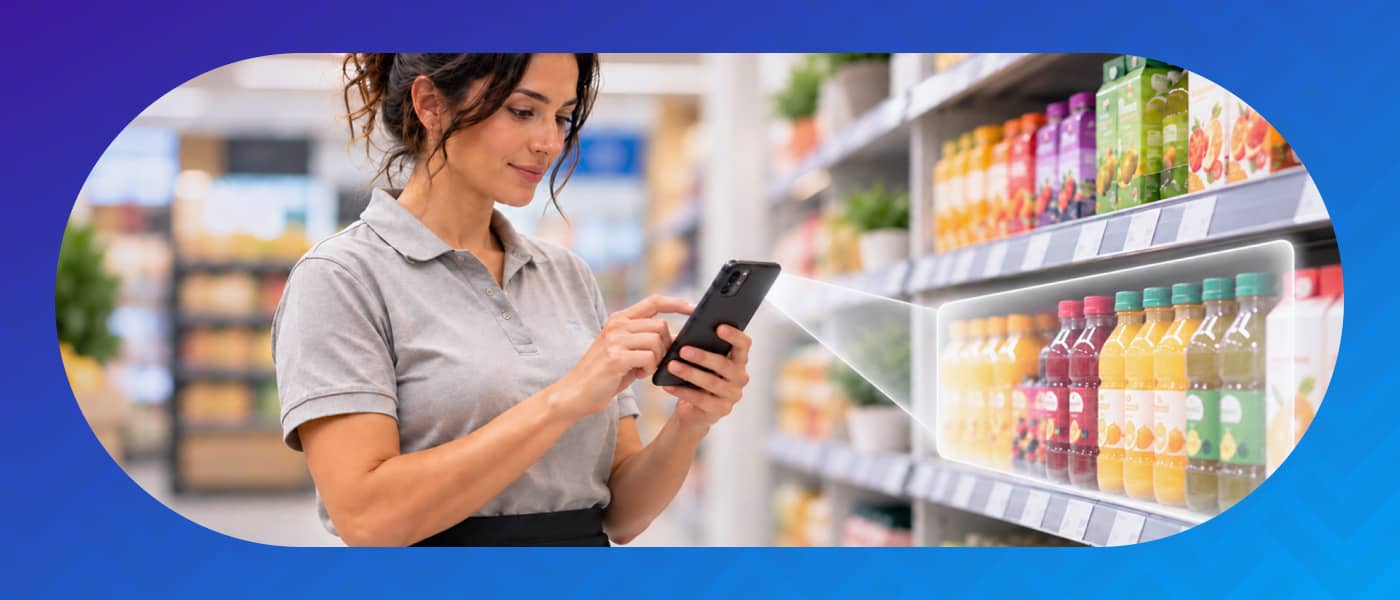
With AI, the process changes: the store team uploads a photo of the execution and the system automatically analyses whether the shelf, window display, or campaign has been correctly implemented, generating immediate feedback without the area manager needing to review each case manually. This does not eliminate human judgement — it focuses it. The manager stops wasting time checking what is right and can focus on correcting what is not.

How does AI optimise in-store execution?
The problem is not always in the planogram. It is in knowing whether it is actually being executed. Studies indicate that real compliance in store sits at around 40%, while the perception from head office is 70%. That 30-point gap represents poorly implemented campaigns, promotions that never reach customers, and sales that never happen.
AI reduces that gap by acting on verification: when the store team uploads a photo of the execution, the system automatically analyses whether it meets expectations and generates immediate feedback. The area manager gains real visibility without travelling, and can concentrate their attention where there are deviations, not where everything is correct.
The difference between the traditional model and the AI model can be summarised as follows:
| Aspect | Traditional merchandising | Merchandising with AI |
|---|---|---|
| Planogram design | Manual, based on experience and negotiation | Automatic, based on sales data and behaviour |
| Updates | Every six months or annually | Dynamic, in real time |
| Compliance audit | Scheduled physical visits | Continuous image recognition |
| Error detection | Days or weeks later | Immediate, with automatic alert |
| Demand forecasting | Simple historical data | Multivariate predictive models |
| Operational cost | High (human resources for control) | Reduced through automation |
The link that closes the cycle: from plan to real execution
AI can generate the perfect planogram and verify that a window display meets brand guidelines. But between that file and the correct shelf in a store is an employee who just started their shift, has eight pending tasks, received the new planogram via WhatsApp three days ago, and is not sure whether the version they have is current.
According to the Zipline State of Retail Execution report (2023), 72% of store employees say they receive communications from head office with incomplete or confusing information. And 64% say that merchandising instructions arrive through different channels each time: email, phone call, WhatsApp, zone meeting.
These are exactly the problems that isEazy Engage solves. The planogram reaches every shift through a single channel, with read confirmation. The team validates execution with a photo taken directly from the app. And if a new employee joins, onboarding and microlearning are available from day one, without depending on the shift manager. The execution problem is not just a people problem. It is a systems problem. And isEazy Engage is that system.

How to communicate and train the store team on new merchandising
If a new planogram is generated every week — or every time seasonality, assortment, or a campaign changes — the store team needs to receive that information clearly, quickly, and verifiably. Not by email. Not by WhatsApp. Through a system that guarantees the message was received, understood, and executed.
These are the levers that truly work to close the gap between plan and execution:
- Centralised and traceable communication: the updated planogram reaches all store employees through the same app, with read confirmation. No different versions, no scattered channels.
- Microlearning integrated into the workflow: alongside the new planogram, the manager can attach a short microlearning module on how to execute it correctly.
- Checklists with photo evidence: the employee validates planogram execution by uploading a photo of the shelf directly from the app. The area manager has real-time visibility without needing to be physically in store.
- Push notifications with context: not a generic alert. It is “this week product X moves to gondola 3, here is the reference image and the verification checklist”.
- Store compliance dashboard: the area manager sees at a glance which stores have completed the update, which have deviations, and where action is needed.
This is exactly the model proposed by isEazy Engage: unifying communication, training, and operations in a single app designed for frontline teams. The result is that the merchandising plan — whether generated by AI or by the trade marketing team — reaches the shelf consistently across all points of sale.
Metrics and control: from intuition to data in merchandising execution
One of the major problems with traditional merchandising is that execution control is based on the area manager’s intuition or on point-in-time audits that only capture a single moment. With a connected operations platform, it is possible to build a system of continuous measurement.
The key metrics that should be monitored are:
- Planogram compliance rate by store and zone: what percentage of points of sale are executing the planogram correctly within the established timeframe.
- Implementation time: how long it takes from the publication of a new planogram to its execution in store. This indicator reveals the efficiency of the communication channel.
- Incident rate: products out of position, unreported gaps, POS materials not placed. With digital checklists and photos, this data is no longer estimated — it is measured.
- Sales impact: correlation between stores with high compliance rates and their sales performance by category. This is the data that justifies the investment to commercial management.
- Team adaptation speed: completion rates of microlearning modules associated with each planogram change, a proxy indicator of the team’s level of understanding.
Moving from “we believe 80% of stores are well executed” to “83% of stores have completed the checklist with a photo in the last 48 hours” is a qualitative leap that changes the conversation between operations, trade marketing, and commercial management.

AI and merchandising by sector: real use cases
The combination of AI and an operations platform for execution is not exclusive to fast-moving consumer goods. It applies to any environment with multiple points of sale and distributed teams:
| Sector | AI application in merchandising | Execution gap solved by Engage |
|---|---|---|
| Fashion retail | Seasonal planograms, size and colour distribution based on sales history | Communicate collection changes and validate window displays with photos |
| FMCG / food | Shelf optimisation by category, out-of-stock detection | Replenishment checklists, new product training, incident reporting |
| Pharma / parapharmacy | Dynamic pricing, expiry management, display compliance | Regulatory compliance instructions, photo validation by SKU |
| Hospitality / food service | Seasonal menu management, counter display optimisation | Real-time menu updates, product training for floor staff |
| Logistics / warehouse | Intelligent slotting, picking route optimisation | Operational instructions, shift verification checklists |
AI verifies the plan. The team makes it real. isEazy Engage closes the cycle
The biggest mistake when implementing AI in merchandising is assuming that technology solves the execution problem on its own. AI can verify whether a window display is correctly implemented, detect deviations in real time, and generate automatic feedback. But the correct shelf in every store, every week, depends on the frontline team receiving the right information, understanding it, and having a system that verifies it has been executed.
The companies winning at merchandising execution are not just those with the best algorithm. They are the ones that have closed the full cycle: a clear plan from head office and a platform that guarantees that plan reaches the shelf consistently across all points of sale.
If your team is still receiving the planogram via WhatsApp, or you have no visibility into how many stores have executed it correctly this week, isEazy Engage is the system that closes that gap. Request a demo.
Frequently asked questions about artificial intelligence and merchandising
What is artificial intelligence applied to merchandising?
Artificial intelligence applied to merchandising is the use of machine learning algorithms, computer vision, and data analysis to optimize product placement, planogram management, and in-store execution. It enables a shift from intuition-based decisions to data-driven ones: which product goes on which shelf, when, and with what expected results. However, AI designs the optimal plan — it is always the store team that executes it in the real world.
What are the main uses of AI in retail merchandising?
The main uses of AI in merchandising include: automatic planogram generation based on sales data and consumer behavior, visual shelf auditing through image recognition, real-time detection of out-of-stock or misplaced products, demand forecasting by category and point of sale, and space optimization by profitability per linear meter. Tools like isEazy Engage ensure these plans reach the store team with integrated training, checklists, and validation.
Why does merchandising execution fail even when AI is used?
Most merchandising execution failures are not algorithm errors — they are human errors: the planogram arrives late, the team does not understand it, there is no way to verify compliance, or area managers lack real-time visibility. According to retail industry data, more than 60% of planogram non-compliance cases are caused by communication or training failures, not design errors. AI solves the what to do; the operations platform solves how to make sure it gets done.
How can an operations app like isEazy Engage improve merchandising execution?
isEazy Engage turns AI-generated merchandising plans into actionable instructions for the store team: push notifications with planogram updates, microlearning content on how to set up a new display, checklists with photo evidence to validate compliance, and real-time dashboards so area managers can spot deviations without physical store visits. The result is more consistent execution across all points of sale, regardless of store volume or team turnover.
Featured articles

Does the information you send from headquarters actually reach all the shifts?
Ensure your network is aligned through a single, traceable channel.
Request a demoContact us

Your stores, all in a row. Your team, unstoppable
Operations, communication, and training all in one AI-powered app. For teams without desktops


Your stores, all in a row. Your team, unstoppable
Operations, communication, and training all in one AI-powered app. For teams without desktops
Related articles


