Your network of stores working as a single team
INDUSTRIES

Retail
Launch campaigns, assign and monitor tasks at each point of sale, in real time.

Restaurants
Communicate with, train, and supervise your front-of-house and kitchen staff.

Hotels & Tourism
All departments are on the same page, from the front desk to housekeeping.

Fashion & Luxury
Promote the brand and run campaigns in each store.

Pharmacy & Health
Protocols, regulatory training, and communication at each facility.

Manufacturing
Instructions, tasks, and on-the-job training, without a computer.
November 10, 2026

CONTENT CREATED BY:
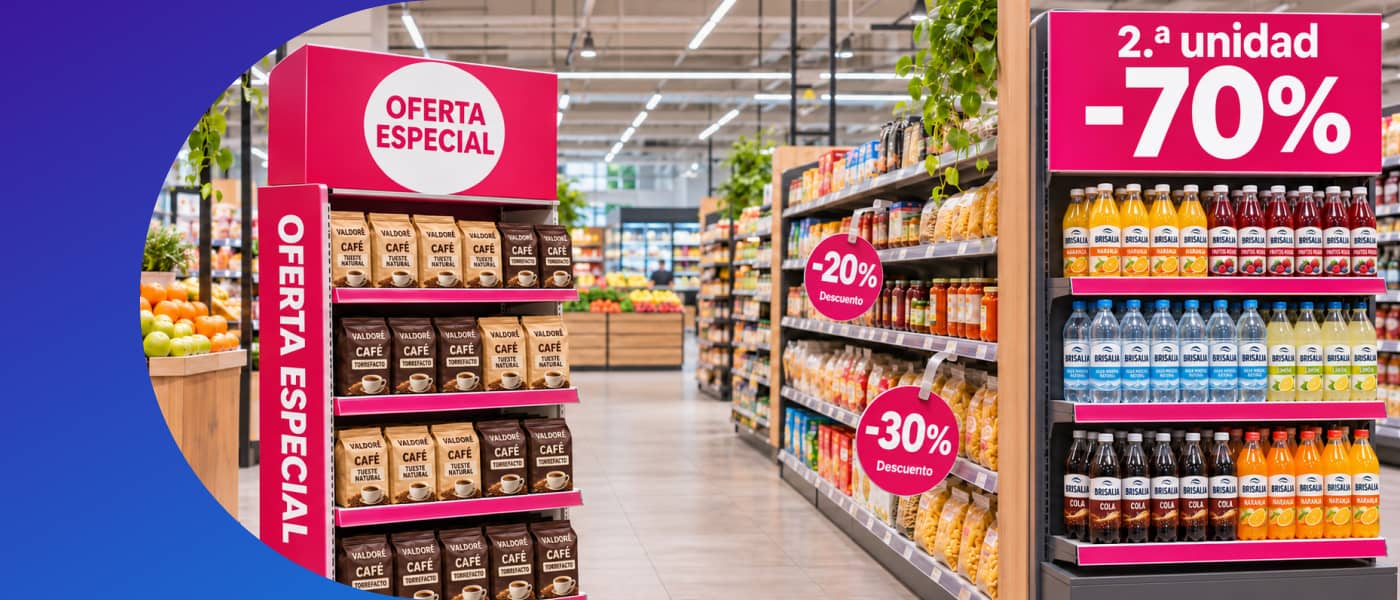
Table of contents
POP advertising — point of purchase — is the set of advertising supports and materials a brand places inside a retail store to influence the buying decision at the exact moment it is made. Floor displays, signage, shelf talkers, stoppers, hanging banners, floor vinyls and digital screens are all POP: they exist so that one specific product gets seen, understood and chosen over the ones sitting next to it.
The textbook definition is narrower than everyday usage. Spanish advertising teaching materials describe the category as messages created to be placed inside stores, and stress that it is an action by the advertiser on the retailer’s space. In other words: POP is placed by the brand, not by the store.
That boundary matters more than it seems, because it explains the underlying operational conflict. POP is designed in a marketing head office, produced at a printer and set up in hundreds of stores by people who took part in neither of the two previous decisions. Between the design and the shelf there is a long chain, and that is where most of the return gets lost.
Almost every problem interpreting the term comes from lumping in things that don’t belong:
It’s also worth separating POP from the acronyms it lives alongside. POS (point of sale) is commonly used for the checkout area and for the terminal that records the transaction. PLV (publicidad en el lugar de venta) is the term used across Spanish-speaking markets, and PDV (punto de venta) is the store itself, the whole outlet. If you work with suppliers or head offices in Spain or Latin America, what you brief as POP will come back on the production order as PLV.
Not every material is after the same thing. Choosing the support is really choosing at which point in the shopper journey you want to intervene: when they walk in and haven’t decided anything, when they’re going down the category aisle, or when they’re already in the checkout queue with a full cart.
| Support | What it solves | Where it pays off most |
|---|---|---|
| Floor display or free-standing unit | Gives the product a location of its own off the shelf and removes direct comparison with the competition | End caps and wide circulation areas |
| Signage and hanging signs | Signposts the category from a distance and steers traffic toward a specific area | Entrance, main aisles and cold zones you want to activate |
| Shelf stoppers and shelf talkers | Breaks the visual line of the shelf and stops the shopper who would walk straight past | The category shelf, at eye level |
| Floor vinyls and directional signage | Creates a route and takes the shopper to an area they wouldn’t visit by default | Transit aisles toward the back of the store |
| Checkout and counter POP | Captures low-ticket impulse purchases while people wait | The checkout area and service counters |
| Digital POP and screens | Lets you change the message without reprinting and adapt it by store, time slot or occasion | Entrance, window and categories with high promotional turnover |
The argument that underpins all POP investment is a single one: a very large share of what ends up in the cart wasn’t decided on the way in. The sector’s reference study is POPAI’s Shopper Engagement Study, which measured real buying behavior in supermarkets by combining intercept interviews, store audits, electroencephalography and synchronized eye-tracking.
Its headline finding: 76% of supermarket buying decisions are made inside the store, up from the 70% the same series of studies had measured in 1995. Of that 76%, most (55 points) is unplanned purchasing; 15 points are “generically planned” purchases, where the shopper knew they needed the category but not the brand; and 6 points are brand switching at the shelf itself.
That breakdown is what really matters when deciding where to put the money. The 15 points of generically planned purchasing and the 6 of brand switching are POP’s natural territory: shoppers already standing in front of the category, who well-placed communication can redirect. The 55 points of unplanned purchasing are the territory of the off-shelf display and of hot spot placement.
One caveat about the figure: the study dates from 2012 and measured the supermarket channel. It remains the most cited reference in the sector and the only one with a published methodology at that scale, but it’s worth treating it as an order of magnitude rather than as a current figure for your own channel.
Your network of stores working as a single team
Unified operations, instant communication, and real-time performance data


Good material in the wrong place performs worse than mediocre material well located. The placement decision rests on three concepts worth being clear about before approving a campaign.
These are the high-footfall, high-visibility areas: entrance, main aisles, end caps and the checkout surroundings. Putting POP in a hot spot multiplies exposure, but it’s also where space is most contested: if your display shares an end cap with three others, the effect gets diluted.
These are the low-traffic, low-visibility areas, typically back corners and aisle ends. Here POP does a different job: it doesn’t amplify traffic that already exists, it tries to create it. Before investing it’s worth reading when it pays to activate a cold zone and when it’s more profitable to accept that the area is visual storage.
Shelf POP (stoppers, shelf talkers, trays) depends on the planogram: if the actual facing doesn’t match the planned one, the material doesn’t fit or covers a product it shouldn’t. That’s why planogram execution and POP setup should be audited in the same visit, not separately. The share of shelf the brand negotiated is the frame within which POP has a right to exist.
All of this is part of the broader system of visual merchandising, the discipline that gives coherence to the store’s entire display.

Here is the problem almost no definition of POP mentions and that nevertheless absorbs most of the budget. A POP campaign isn’t evaluated by what was designed or by what was shipped: it’s evaluated by what a shopper actually found in the store. And that last link fails far more often than head offices assume.
POPAI and Quri measured exactly that in their Compliance Initiative, presented in January 2015 and based on more than 5,000 in-store observations across the supermarket, big-box, drugstore and dollar store channels. The result, in their own words: on average, only around half of the stores had the planned display correctly executed. The other half did not. The report concludes that real implementation compliance is “significantly lower” than the industry perceives.
Translated into budget: if half the material never fulfills its function, the cost per real impact doubles, and the post-campaign measurement compares sales from stores that set it up with stores that didn’t, without knowing it. Mediocre results then get blamed on the creative, the product or the price, when the cause was execution.
| Execution failure | What you see in the store | How you detect it |
|---|---|---|
| It never gets set up | The material is still in the warehouse or unopened in the back room | Mandatory photo of the placement on the start date |
| It gets set up late | The display appears when the campaign has been running for two weeks | Time stamp on the evidence against the activation date |
| It gets set up somewhere else | The display ends up in a secondary aisle because the end cap was taken | Photo with the context of the area, not just the material |
| It gets set up incomplete | The display header, the sign or half the lines are missing | A checklist by element, not a single "set up: yes/no" |
| It runs out of product | The display is there, but empty after three days and nobody restocks it | A mid-campaign check, not only one at the start |
| It never gets taken down | It keeps advertising an expired promotion weeks later | A teardown task with its own date and evidence |
Measuring POP has two layers that often get confused. The first is execution: is it up, in the right place, complete and stocked? The second is outcome: did it sell more? The second means nothing without the first, because without knowing which stores set it up you can’t build an honest control group.
For the execution layer, the indicator that organizes everything else is store compliance: the percentage of outlets that implemented the campaign as it was defined. It’s worth measuring with time-stamped photographic evidence and a breakdown by element, not with a self-declaration from the store manager.
For the outcome layer, the relevant retail KPIs are the change in sales of the line against the previous period, turnover in the area where it was placed and sales per square meter in that location. Cross-referencing both layers answers the only question that matters at the end of a campaign: did the idea work badly, or did the setup work badly?
The retail audit is the process that joins the two, and its value depends entirely on its frequency: an audit at the end of the campaign is useful for the report, not for fixing anything.
The gap between the approved campaign and the set-up shelf is a communication and operations problem, not a graphic design one. The chains that solve it well share three things: instructions that reach the right worker, evidence that comes back without friction, and a deadline everyone can see.
With isEazy Engage, a POP campaign rolls out as a task with a date, recipients and mandatory evidence. Task management lets you send each store which material to set up, in which location and with which lines, and receive the photo of the result with its time stamp; employee communication ensures the campaign briefing doesn’t get lost in an email chain store staff don’t read; and frontline team training solves the most frequent reason for an incorrect setup, which isn’t carelessness but that nobody explained how that display goes together.
For a retail chain with dozens or hundreds of outlets, the practical effect is being able to see compliance store by store on the launch day itself and act on the ones missing, instead of discovering it in the closing audit. If you manage several outlets, these store management and retail operations principles complement the above, and retail training is the piece that sustains setup quality campaign after campaign.
Point of purchase advertising remains one of retail’s most profitable levers for a measured, documented reason: most buying decisions are made inside the store, in front of the product. But that profitability is potential, not automatic.
The uncomfortable figure in the sector is that around half of the planned material never ends up correctly implemented. As long as that number goes unmeasured, any conclusion about whether a POP campaign “worked” is comparing stores that set it up with stores that didn’t, and blaming the message for a problem that was operational.
The practical consequence is simple: before investing more in creative or production, it’s worth knowing what percentage of the network sets up what it’s asked to, when it sets it up and how faithfully to the brief. That is the number that turns a POP budget into a measurable investment.
POP stands for point of purchase. It refers to the set of advertising supports a brand places inside a retail store — displays, signage, stoppers, floor vinyls, screens — to influence the buying decision at the point of sale itself. In Spanish-speaking markets the equivalent term is PLV, from publicidad en el lugar de venta.
POS (point of sale) is commonly used for the checkout area and for the terminal that records the transaction. PLV (publicidad en el lugar de venta) is the Spanish-language equivalent of POP and is used interchangeably with it internationally. PDV (punto de venta) is the outlet itself, the whole store. POP is therefore the brand’s advertising material inside the outlet, not the outlet and not the checkout.
No. Packaging is part of the product and communicates on the shelf, but it isn’t advertising material placed in the store. Merchandising is the discipline that organizes space, assortment and display, and POP is only one of its instruments. Nor is the signage a retailer produces itself to indicate products, prices or quality grades: that is retailer communication, not advertiser communication.
With time-stamped photographic evidence per store and a breakdown by element, not with a self-declaration from the manager. The main indicator is store compliance: the percentage of outlets that implemented the campaign as it was defined, in the planned location, complete and stocked. That measurement should happen at launch and mid-campaign, because a display that was set up can be sitting empty a few days later.

Ensure your network is aligned through a single, traceable channel.
Request a demoContact us
Your stores, all in a row. Your team, unstoppable
Operations, communication, and training all in one AI-powered app. For teams without desktops