Your network of stores working as a single team
INDUSTRIES

Retail
Launch campaigns, assign and monitor tasks at each point of sale, in real time.

Restaurants
Communicate with, train, and supervise your front-of-house and kitchen staff.

Hotels & Tourism
All departments are on the same page, from the front desk to housekeeping.

Fashion & Luxury
Promote the brand and run campaigns in each store.

Pharmacy & Health
Protocols, regulatory training, and communication at each facility.

Manufacturing
Instructions, tasks, and on-the-job training, without a computer.
November 3, 2026

CONTENT CREATED BY:
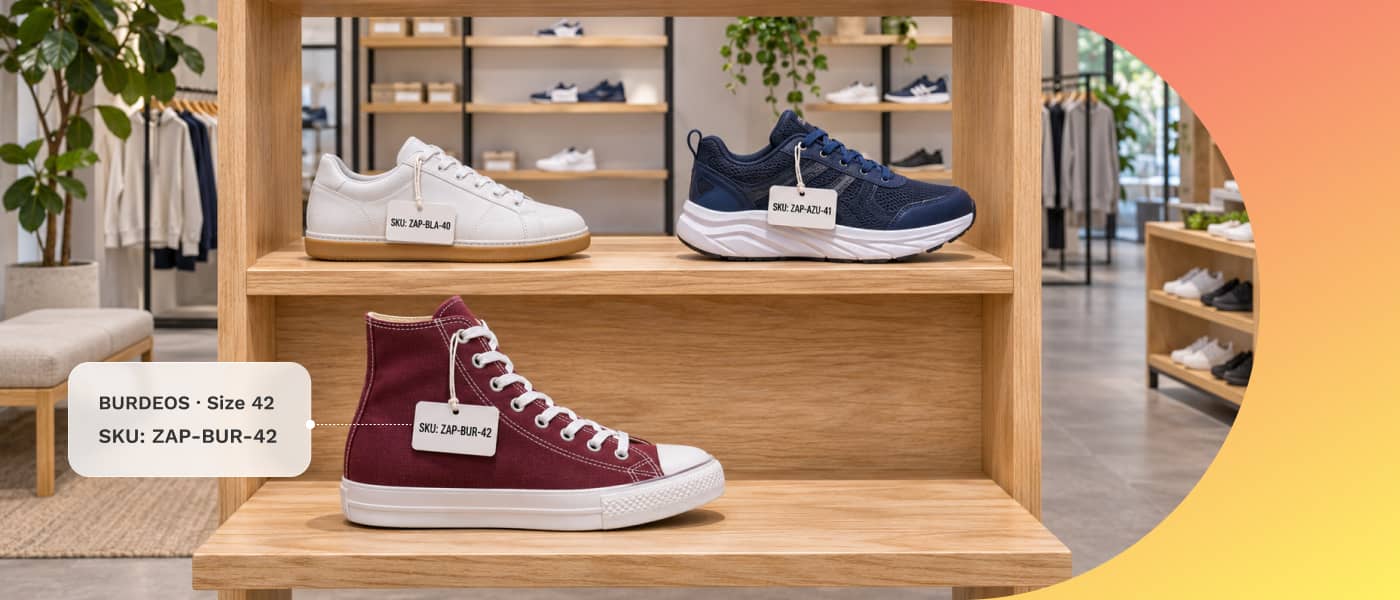
Table of contents
A SKU (stock keeping unit) is the unique internal code a company uses to identify every distinct item it sells or stores. It’s alphanumeric, each company defines it with its own criteria, and it serves one very specific purpose: so that when someone says “there are three left”, everyone knows exactly three of what.
The word “distinct” is doing all the work. A T-shirt isn’t a SKU: the blue T-shirt in size M is a SKU, and the same blue T-shirt in size L is another one. The SKU doesn’t identify the product, it identifies the specific variant that gets sold, counted and replenished.
A vocabulary note that saves confusion: inside a company, SKUs sometimes travel under other names —“item number”, “part number”, “style-color-size code”— depending on the system that generated them. They’re all the same thing, and in an assortment report “number of items” and “number of SKUs” measure exactly the same figure. If you want to place it in the context of the sector, here’s an overview of what retail is.
This is the most common confusion in inventory and the one that wastes the most time in an integration, a catalog setup or a count. Worth settling once and for all: the SKU is yours; the UPC belongs to everyone.
| Code | Who assigns it | What it’s for |
|---|---|---|
| SKU | Your own company, using whatever criteria it decides | Identifying each variant internally: stock, replenishment, sales and warehouse location. It only means something inside your organization |
| GTIN | GS1, through the company prefix it assigns to the manufacturer | It’s the umbrella: the global product identifier, identical for everyone who sells it. UPC and EAN are formats of it |
| UPC | GS1 (it’s the 12-digit GTIN) | The standard barcode in the United States and Canada. It’s what the register scanner reads and what marketplaces ask for |
| EAN-13 | GS1 (it’s the 13-digit GTIN) | The European equivalent. Every UPC is a GTIN, but not every GTIN is a UPC |
| Vendor part number | The manufacturer or distributor selling to you | Identifying the item in their catalog and on their packing slips. It doesn’t have to resemble your SKU at all |
There’s a practical consequence of the table above worth keeping in mind: two items can share a UPC and still need different SKUs, and vice versa. If you sell the same product bought from two suppliers, the UPC is identical but you may want to separate them to track cost; if you build a promotional three-pack, that’s a new SKU and also a new GTIN.
That second part isn’t an opinion. GS1 requires a different identifier for every size and color combination, and also when the declared net content changes or when a certification mark is added to or removed from the packaging. The criterion it applies is simple and works just as well for deciding your internal SKUs: if the customer or your trading partner needs to tell the item apart from the previous one, it’s a different item.
An example with round numbers. A T-shirt in 3 colors and 4 sizes isn’t one product in your inventory: it’s 12 SKUs. Add two more colors next season and you’re at 20. That’s why the SKU count grows much faster than the commercial catalog, and why an assortment that takes up one page in a brochure can be an inventory of several thousand lines.

There’s no standard to comply with: the SKU is yours and you can build it however you like. What there is, is plenty of ways to build it badly. The approach that works is a segmented code, of fixed length, where each block always means the same thing, ordered from the most general to the most specific. That way it reads at a glance and can be filtered and grouped in any spreadsheet.
An example for a short-sleeve blue T-shirt in size M from the spring-summer 2026 season: TEE-SS-BL-M-SS26.
| Segment | What it encodes | In the example |
|---|---|---|
| TEE | Product category | T-shirt |
| SS | Subcategory or style | Short sleeve |
| BL | Variant-creating attribute: color | Blue |
| M | Variant-creating attribute: size | Size M |
| SS26 | Season, batch or year | Spring-summer 2026 |
The SKU is retail’s minimum unit of analysis: below it, nothing can be measured. As soon as each variant has its own code, you get the indicators that really decide what gets bought, what gets replenished and what gets dropped.
They all fit into the same store dashboard, which you’ve got developed in retail KPIs.
Your network of stores working as a single team
Unified operations, instant communication, and real-time performance data


This is the part that articles about SKUs usually don’t cover, and the one that moves the most money. A SKU isn’t a code: it’s the promise that behind that code there’s a specific product in a specific place. And that promise is held up by the system record, not by the shelf.
The most instructive thing measured on this is the work of Nicole DeHoratius and Ananth Raman, published in Management Science in 2008. They reviewed nearly 370,000 inventory records across 37 stores of a single retailer, comparing what the system said with what was actually there. The result: 65% of the records were inaccurate.
It’s worth reading carefully, because it’s one retailer and not a sector average, and because “inaccurate” covers everything from a one-unit discrepancy to a serious error. But the order of magnitude matches what anyone who has run a physical count has seen. The study also adds two very actionable findings: inaccuracy drops where inventory audit practices exist and rises with the complexity of the store environment. In other words, it isn’t a software problem but an operational one, which is why it isn’t solved by retail digitalization alone.
The phenomenon has a name of its own: phantom inventory. The system thinks there are four units of a SKU left, so it doesn’t trigger the replenishment order; in the store there are none, because they were lost, stolen, returned incorrectly, or they’re in the back room behind something else. The SKU doesn’t sell, the algorithm reads that as no demand and cuts the next order. Nobody finds out, and the item disappears from the assortment in the quietest way possible.
The question always comes up, and the honest answer is that the evidence is split. But it’s split in a very useful way.
In favor of cutting: Peter Boatwright and Joseph Nunes, in Journal of Marketing (2001), studied a major assortment reduction at an online supermarket. Across 42 categories, where mostly low-selling SKUs were removed, sales rose 11% on average and grew in more than two thirds of the categories. The usual reading is the right one: too much assortment confuses, and pruning the long tail usually improves the category.
Against, and with data from the same retailer: Borle, Boatwright, Kadane, Nunes and Shmueli, in Marketing Science (2005), measured the effect at store level instead of category level. Total sales fell, and the greater damage didn’t come from people buying less per visit, but from them coming in fewer times. Infrequently purchased categories were the hardest hit.
The practical conclusion isn’t “cut” or “don’t cut”, but measure where: a SKU can be irrelevant within its category and, at the same time, be the reason a customer picks your store over the one across the street. That’s why an assortment decision shouldn’t be made with the turn-rate report alone in front of you, and even less so if it’s applied identically across the whole network without looking at how each store is managed.
All SKU management rests, in the end, on what five or ten people do during their shift. These are the four routines that keep the data alive, and none of them is technological:
At bottom it’s the same execution problem that shows up in the retail audit, in planogram execution, in visual merchandising and in store compliance. And it depends on three very specific things: that the standard is accessible at the moment of use —that’s what good SOPs are for—, that the task is assigned with a date and evidence, and that the store has somewhere to answer back. Digital task management is what turns those three things into routine rather than good intentions.
Three things worth keeping. That the SKU is internal and the UPC is global, and confusing them breaks integrations and catalog setups. That every variant is a SKU, so inventory grows much faster than the commercial catalog. And that a well-built code —fixed length, meaningful segments, never reusing retired ones— saves you years of unreadable history.
But above all, that a SKU is only useful if the number next to it is true. With 65% of records measured as inaccurate in the field, the inventory bottleneck isn’t in the software: it’s in what happens in the store during the shift. isEazy Engage works precisely there: it brings together, in a single app, communication with the teams, bite-sized training people can take right at their workstation, and task assignment with evidence, so that what the system says you have is what the customer finds on the shelf.
SKU stands for stock keeping unit. It’s the unique internal code a company uses to identify each specific product variant it sells or stores. Inside a company it sometimes travels under other names —item number, part number, style-color-size code— depending on the system that generated it, but they all refer to exactly the same thing.
The SKU is internal: you create it yourself, with whatever criteria you want, and it only means something inside your company. The UPC is global: GS1 assigns it through the manufacturer’s company prefix, it’s identical for everyone selling that product, and it’s the barcode the register scanner reads. Two items can share a UPC and have different SKUs —for example, the same product bought from two suppliers— which is why neither one replaces the other.
Yes. The SKU doesn’t identify the product, but the variant that gets counted and replenished: a T-shirt in three colors and four sizes is twelve SKUs, not one. GS1 applies the same criterion to global identifiers and requires a different GTIN for every size and color combination, as well as when the declared net content changes or a certification mark is added to or removed from the packaging.
The evidence is split and it’s worth knowing both sides. Boatwright and Nunes (Journal of Marketing, 2001) measured a deep assortment cut across 42 categories at an online supermarket and found sales rose 11% on average. Borle, Boatwright, Kadane, Nunes and Shmueli (Marketing Science, 2005), using data from the same retailer but measuring at store level, found total sales fell, mainly because customers came back fewer times. The practical reading is that a SKU can be irrelevant in its category and, at the same time, be the reason someone chooses your store.

Ensure your network is aligned through a single, traceable channel.
Request a demoContact us
Your stores, all in a row. Your team, unstoppable
Operations, communication, and training all in one AI-powered app. For teams without desktops